

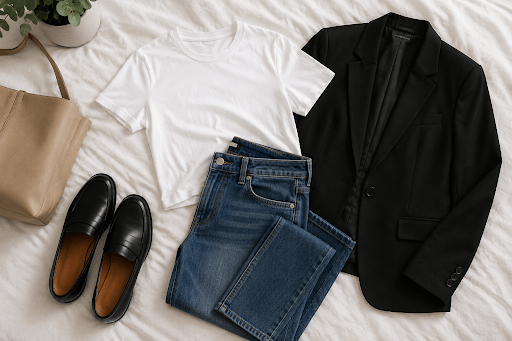
Open your closet right now. There’s a decent chance half of it is stuff you bought because it was on sale or because an influencer wore it once or because you needed something for an event three years ago.
And there’s probably a smaller pile, maybe six or seven pieces, that you reach for constantly. That smaller pile is basic fashion pieces doing their job.
Everything else is noise.
People throw around “basics” like it’s some magic word, usually followed by a list of 20 or 30 items you’re supposed to buy. Most of those lists get it wrong, honestly. It’s not a number thing. It’s whether a piece earns its spot in rotation or just sits there taking up hanger space.
What Actually Counts as a Basic
A real basic works with almost everything you already own. It doesn’t scream a specific year. And it survives more than one season of actual wear, not just careful hand-washing on a hanger somewhere.
Skip any of that and what you’ve got isn’t a basic it’s a plain-colored trend piece wearing a disguise.
Take a white button-down. Classic basic, right? Depends. If the cut still looks normal in five years, sure. But a boxy, oversized white shirt with dropped shoulders? That’s just 2024 wearing a basic’s colors.
This is the part most lists skip. Most checklists just toss out “white tee, dark jeans, black blazer” and leave it there nobody tells you why those pieces made the list and, say, a graphic tee didn’t.
What Your Closet Actually Needs
Forget the giant numbered list. Think category by category, and fill each one with things that actually work for your life, not whatever’s blowing up on someone’s Pinterest board this week.
Tops
Grab a plain white tee first, and go heavier cotton. The thin stuff wears out fast. Add a fitted long-sleeve for layering and a button-down in some neutral color and that covers most days on its own. Throw in one decent knit sweater, something that survives more than three washes without pilling and you’re basically set.
Bottoms
Get a pair of jeans that actually fits you today, not ten pounds ago. A tailored trouser in black or navy. That’s genuinely enough to start everything else seasonal or occasion-specific.
Outerwear
A structured jacket that works over both a dress and jeans, plus something warmer for actual cold. This is where cost-per-wear math matters most, since a good coat gets worn hundreds of times a year.
Shoes
One versatile flat or sneaker, one slightly dressier option that isn’t painful after two hours standing.
Everything past those two pairs is preference, not necessity.
Accessories
A belt. A bag you’re not afraid to scuff up a little. One piece of jewelry that goes with basically everything.
Tiny category, but it does a lot of heavy lifting for how “put together” something looks.
Signs a Fabric Is Actually Good Quality
Two shirts can look exactly the same hanging in the store and turn into completely different pieces after ten washes. This is exactly where people get burned. They judge a basic by color and cut alone, then can’t figure out why it’s pilling or sagging by month three.
Here’s What to Check
Hold the fabric up to light. If you can see straight through an “opaque” white tee, it’s thin enough to pill fast and won’t hide seams underneath other layers. Scrunch a handful of the fabric in your fist good weight springs back close to flat and if it stays wrinkled, that’s a tell. For knits, give the cuff a gentle stretch. It should snap back right away, not sag there looking sad.
Fibers Worth the Extra Cost
Heavier cotton wins here, hands down check the gsm if it’s listed or just go by feel. Wool and wool blends handle wrinkles and odor way better than synthetics when it comes to knitwear. Denim’s trickier. A bit of stretch won’t hurt, but rigid, 100% cotton denim tends to hold its shape better over time than the heavily stretch-blended kind, even if the cotton feels stiffer on the hanger.
Synthetics aren’t the enemy here; a good technical jacket practically needs them to handle weather. It just means checking what a fabric is actually built for before assuming “basic” automatically means “good quality.”
When to Skip a Basic Entirely
Not every category needs filling right away. It really depends on your life. Someone working from home five days a week doesn’t need a tailored trouser nearly as bad as someone heading into an office. Winters that barely dip below 60°F? Heavy outerwear’s just closet clutter at that point, money sitting on a hanger.
These categories are more of a starting point than a rulebook, honestly. Skip whatever doesn’t apply and put that money toward the piece you’ll actually wear.
Ask one question before buying: would this have looked normal five years ago and will it look normal five years from now? If the answer’s no to either half, it’s a trend piece, not a basic which is fine, as long as you’re buying it knowing that, not thinking it’s a long-term investment.
Color’s the biggest giveaway. True neutrals barely move: black, white, navy, camel, gray. But the second a “neutral” starts leaning into some specific shade sage green, terracotta, that dusty lilac every brand pushes a couple springs back its trend logic is just wearing a staple’s name tag.
Why Spending More on Basics Actually Pays Off
Do the math on a $40 shirt that falls apart after four wears — that’s $10 every time you put it on. A $120 shirt lasting 200 wears? Barely 60 cents a wear. That’s basically the whole argument for spending more on basics right there. The math just flips once you factor how long something actually lasts.
Do the math before buying, especially on outerwear and shoes, since those get the highest wear counts of anything in a closet.
Building This Over Time, Not All at Once
Nobody needs to buy a full set of basic fashion pieces in one weekend and honestly, trying to usually means rushing into wrong sizes or wrong shades of “black” that don’t actually match anything else.
Replace the most worn-out piece first normally with shoes or a coat then work outward from there.
The Closet Essentials guide at The Lifestyle Edit breaks this down further if you’re starting from a closet that’s more trend pieces than basics right now, which, honestly, describes most closets at some point.
FAQ
How many basic fashion pieces do I actually need?
There’s no fixed number. A workable starting point is one to two pieces per category tops, bottoms, outerwear, shoes, accessories built up gradually rather than bought all at once.
Are basics boring?
Depends on the fit, honestly. Get the fit and fabric right and the basics looks intentional, not boring most “boring” basics are really just badly fitted ones.
Should basics come in trendy colors, or stick to neutrals?
Skip it. Trend colors date fast, even in a “basic” style. Keep the color experiments for cheap pieces you’re not counting on lasting past this year.
Capsule wardrobe vs. just owning basics — what’s the actual difference?
Think of basics as the building blocks. A capsule wardrobe takes those blocks and narrows them down to a fixed set built for one season or purpose; you can absolutely own good basics without ever putting together a formal capsule.
Should you repair a basic or just replace it?
Usually, repair it. A patched hole or reinforced hem costs way less than buying new and it’s one of those tricks people forget about for keeping cost-per-wear down. Never mended anything before? NPR’s guide to visible mending is a decent place to start.
Most closets don’t actually need more clothes. They need fewer pieces pulling more weight, which is really the whole point of basic fashion pieces to begin with. Start with whatever’s falling apart first, swap it for something built to last and let everything else catch up on its own time.