

Here’s the annoying part: your closet is packed and you still stand there most mornings with nothing to wear. Almost everyone I know deals with this. And the fix isn’t buying more. It’s the opposite of fewer clothes, but ones that actually earn a spot.
This isn’t some challenge where you own ten items and pat yourself on the back minimalist wardrobe checklist. It’s just a list. Clothes that fit right. Clothes that match what you already own. Stuff you can grab without standing there debating how you feel about a shirt at 7am.So here’s what I’d actually put on that list.
It Really Comes Down to One Thing
It’s a Decision Problem, Not a Clothes Problem
You’ve got ten shirts. You’re running late. Somehow none of them feel right. Sound familiar? That’s not a shortage of clothes that’s a matching problem in disguise. Fix the matching and suddenly every piece works with two or three others. You grab something. You go.
I keep thinking about Donna Karan’s old “Seven Easy Pieces” idea, honestly more than I probably need to. A handful of pieces that work together will always beat a closet crammed with stuff that doesn’t. That’s really it. That’s the whole idea behind this entire list.
Step 1: Clear Out Before You Add Anything
Take it all out. Every last thing, including whatever’s been shoved in the back that you forgot you even owned.
Sort Into Three Piles
Wear-it-a-lot. Haven’t-touched-it-in-a-year. Doesn’t-fit-right-anymore.Start with pile one. That soft gray shirt you reach for every week is doing more work than the fancy top you wore exactly once and can’t even remember buying. Letting go of that top is somehow harder than it should be tags on or off, doesn’t matter.
Step 2: Pick Your Closet Essentials
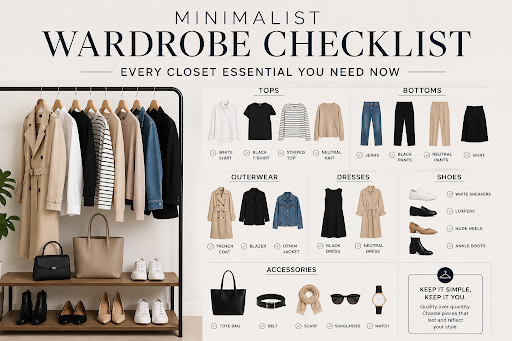
Okay, this is the part everyone’s actually here for.Tops-wise: a couple plain t-shirts, one button-down, a sweater you’d genuinely reach for. Pants are the annoying part of jeans that actually fit (harder to find than anyone admits), one neutral pair and a skirt if that’s your thing. Then one jacket, one coat. Shoes: sneakers, flats, boots.
That lands you around twelve to fifteen pieces. It’s not a rule carved in stone, more of a starting point you bend around your job, your climate, your actual life. The one rule that does hold: everything has to match everything else.
Step 3: Choose a Simple Color Palette
Everyone skips this step. Which is a shame, since it’s the one that actually matters most.
Colors That Work Together, Not Against Each Other
Here’s the annoying part about picking colors piece by piece: a shirt can look great on its own, the pants can look great on their own, and then you put them on together and it’s just… wrong. Not “wrong” like you can point to why. Just off. Stay in one color family and suddenly things start matching without any effort on your part.
Two or three neutrals black, white, gray, navy, whatever suits you plus one accent color you’re actually attached to. Anything new you buy needs to fit that palette. Not fight it.
Step 4: Take Your Time With What You Buy
Rushing gets you the wrong things fast,minimalist wardrobe checklist patience gets you the right things slowly, which sounds obvious until you’re standing in a store at 8pm needing “something.”
Buy one piece. Live with it a bit. Then figure out what’s actually still missing before grabbing the next thing. Cost per wear matters way more than the price tag. A $10 shirt worn once is a worse deal than a $40 shirt worn every week. Target and Uniqlo handle basics just fine. Thrift stores too, especially for tees and jeans, since nobody’s checking labels on those anyway.
Step 5: Skip the Common Mistakes
The “Someday” Clothes Trap
You know the ones. The dress that fit a size ago. The suit from an interview that led nowhere. They sit there for years and somehow the closet still feels stuffed even though half of it never gets touched.
They sit there for years.Despite the fact that half of the closet might not be used at all, it still seems very full. Store away only what you would wear shortly, not something you will wear “someday.”
How Many Pieces Should Be in a Minimalist Wardrobe
Many folks obsess over a specific number that they think is somehow the answer. There isn’t.
There isn’t, though. Twenty pieces works fine for some people. Others need thirty because of their job or the weather where they live. Neither is wrong. Just starting out? Twenty-five is a reasonable target and that’s not even counting workout clothes.For more on this, check out our capsule wardrobe post.
Your Minimalist Wardrobe Checklist, All in One Place
A closet that actually works doesn’t need to be huge. It just needs pieces that fit, match and get worn. Start with what you’ve already got. Clear out what isn’t working. Add things slowly. Stick to your colors.That’s really the whole checklist. No hacks, no tricks, just fewer clothes that deserve to be there.Want more tips like this? Check out The Lifestyle Edit.
FAQ
What is a minimalist wardrobe checklist?
A short list of closet pieces that all match each other. It’s meant to get you dressed fast without eating up your morning.
How many clothes do I actually need?
Depends entirely on you. Most people land somewhere between twenty and thirty once things settle.
What colors work best?
Neutrals do most of the heavy lifting black, white, gray, navy. Add one accent color you genuinely love wearing.
Can I build this on a budget?
Yes, pretty easily actually. Start with what’s already in your closet, add slowly and check thrift stores for basics.
Do I need to throw away everything that I have?
No. You should keep the clothes that you wear all the time and throw away only those that you don’t wear anymore.