

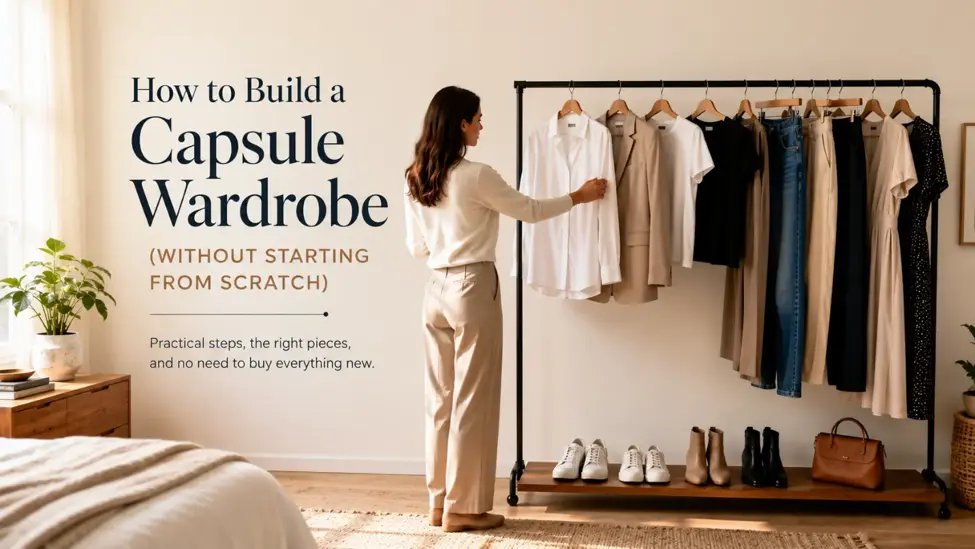
You open your closet. There’s plenty in there 40-something things, probably but somehow nothing to wear. Nothing matches. Half of it doesn’t fit right anymore. None of it makes you want to get dressed.
That’s the problem a capsule wardrobe actually fixes. If you’ve been putting this off because it sounds like a big project toss everything, buy a whole new closet it’s not that. Building a capsule wardrobe mostly just means you stop shopping randomly and get a little pickier about what’s hanging in there.
Here’s how to do it without losing your mind over it.
What Is a Capsule Wardrobe, Really?
A capsule wardrobe is a small set of clothes that all work together. Every piece pair with at least two or three other things you already own. You grab something, throw it on, done no digging through three drawers for the one top that matches those pants.
A London boutique owner named Susie Faux coined the term back in the 1970s for a tight, interchangeable closet built around good basics. Donna Karan ran with it in the 1980s with her “Seven Easy Pieces” collection a handful of pieces that could take a woman from a morning meeting to dinner without a wardrobe change in between.
The goal hasn’t really changed since then: fewer decisions in the morning, more confidence once you’re out the door.
Step 1 Go Through What You Already Own
Before you buy anything, set aside an hour and pull everything out of your closet. All of it.
Sort it into three piles: stuff you wear constantly, stuff you haven’t touched in over a year, and stuff that doesn’t fit anymore. The first pile is where you start. Those are the clothes already working for your real life.
Don’t rush past this. A worn-soft white tee you grab every week does more for your capsule than a trendy blazer you bought on sale and wore twice. The clothes you already love is the foundation everything else gets built around them.
While you’re sorting, pay attention to patterns. Do you keep reaching for the same handful of colours? Do you basically live in jeans and a top, or do you wear dresses more than you thought? You already know the answer. You’re just listening to it for once.
Step 2 Pick Your Capsule Wardrobe Colour Palette
Pick your colour palette before anything else. Most guides skip this step, but it’s the one that actually makes the rest of the process work without it, you end up with clothes that are all nice on their own but don’t talk to each other in the closet . If you’ve got tops in every colour and bottoms all over the place, nothing coordinates naturally. But if most of your pieces sit within the same colour family, outfits just happen.
Then add 1 or 2 accent colours that you genuinely like wearing. Not what’s trending. What you actually put on.
If you live in earth tones and reach for olive and rust constantly, your palette is already there. Build on that. If you always feel most like yourself in navy and white, that’s your answer.
Step 3 Know Your Capsule Wardrobe Essentials
It isn’t about having a particular number of items. Usually, most individuals will find themselves with 25 to 40 items, but again, this number is flexible because what counts is not the quantity but the quality of the clothing items.
Here’s a starting framework not a rigid checklist, but a starting point:
Tops (6–8 pieces)
A couple of fitted tees in your neutral colours. A classic white button-down.
Bottoms (4–5 pieces)
A pair of well-fitting straight or wide-leg jeans. Tailored trousers in a neutral. A versatile skirt midi length works for most lifestyles. A pair of shorts if your climate calls for it.
Dresses (2–3 pieces)
At least one that handles multiple settings a relaxed midi in a solid neutral is the workhorse. One slightly dressier option for occasions.
Outerwear (2–3 pieces)
A coat or jacket that works with most of your wardrobe. A lighter layer for year-round use a blazer or a linen shirt you can throw over things.
Shoes (3–4 pairs)
A clean sneaker. A flat or low heel. A sandal. A boot if you live somewhere with actual seasons.
These are your minimalist wardrobe basics the foundation. Once these are solid, you can add things intentionally rather than randomly.
Step 4 Figure Out Your Budget Before You Shop
A capsule wardrobe on a budget is completely doable. The concept is not about buying expensive clothes.
The pieces from your first pile the ones you wear constantly are already in your capsule. You don’t need to replace them.
For the gaps, think about cost per wear, not the price tag. A $15 top you wear twice is more expensive than a $60 one you reach for every week. That’s the actual math of building a smart wardrobe.
Target, H&M, Ever Lane, and Madewell are solid options at different price points Second-hand shops such as Theda, Postmark, and Depop may be places to look into when shopping for clothes, particularly for timeless items such as white T-shirts, straight-legged pants, and neutral blazers that don’t need branding.
Purchase one or two items at a time.. Don’t try to build the whole thing in a weekend shopping trip.
Step 5 Add Wardrobe Staples That Work for Your Actual Life
Here’s where most capsule wardrobe guides fall flat. They hand you a generic list white tee, black pants, trench coat and call it done. But a teacher’s capsule looks different from a freelancer’s, which looks different from someone who works in an office five days a week.
Think about your actual week What are some things that you would like more choice about?
If you work at home, do errands, and sometimes eat out with friends, then your capsule will be completely different than those who commute to an office every day. There’s no wrong answer. The key is that your wardrobe will support your life, not what anyone else thought you were living.
Basic wardrobe items for women are not one-size-fits-all.. They’re specific to the woman. Start there.
How Many Clothes Should Be in a Capsule Wardrobe?
People get hung up on this. The honest answer: however many you’ll actually wear.
Some people run on 25 pieces and feel completely set. Others need 40 because their lifestyle genuinely demands more variety different climates across seasons, workwear requirements, active kids. Both will do fine.
But for the beginners, it would be wise to set a target of 30 items. This way, you’ll not feel constrained on any particular day. You can always cut down on the number as you go along.
The number is a tool. It’s not the point.
Common Mistakes When Building a Capsule Wardrobe
The need to purchase pieces that could possibly work as opposed to pieces that you will love to wear. If there is hesitation when shopping, leave it behind. It will not work if you don’t have the desire to wear the pieces in your capsule.
Possession of pieces labelled “someday.” The outfit that you will wear after dropping ten pounds. The suit purchased for an interview three years ago but still never worn. They are filling your closet unnecessarily and giving the illusion that you have a cluttered closet.
The idea that everything can be done instantly. There is no such thing as an instant capsule wardrobe. Wear pieces, see what you’re missing, and buy things in order to fill those gaps.
Build a Wardrobe That Actually Works for You
A capsule wardrobe isn’t a minimalism challenge or a Pinterest aesthetic. It’s just a smarter way to get dressed once everything works with everything else, you stop standing in front of your closet every morning.
Start with what you already have. Fill the gaps slowly. Keep only what you actually wear.
If you want more on this, The Lifestyle Edit has guides on capsule essentials and outfit ideas worth a look if you’re past the flat-lay-photo stage and just want clothes that work.
FAQ
Do a closet audit first. Pull everything out, then split it into what you actually wear and what’s just dead weight. Whatever you reach for constantly that’s your starting point. Build from there instead of starting over completely.
For most people, 25 to 40 not counting underwear, gym clothes, or accessories. There’s no magic number. The right size is whatever gets you dressed in five minutes without you standing there wondering what’s missing.
Sure , start with what’s already in your closet and add pieces slowly instead of trying to do it all at once.
Neutral base colours black, white, navy, cream, camel, Gray are easiest to mix and match hen pick one or two colours you genuinely love and let those be your personality. The goal isn’t a beige life it’s not standing there at 7am holding two shirts wondering if they clash.